Tea tree
Melaleuca alternifolia (Maiden & Betche) Cheel
Watch: About Tea Tree with Jade Shutes
Watch: Aromatic Plant Exploration with Tea Tree & Jade Shutes
BOTANICAL INFORMATION
Common name: Tea tree
Scientific name: Melaleuca alternifolia (Maiden & Betche) Cheel
Botanical family: Myrtaceae
Conservation status: Not defined
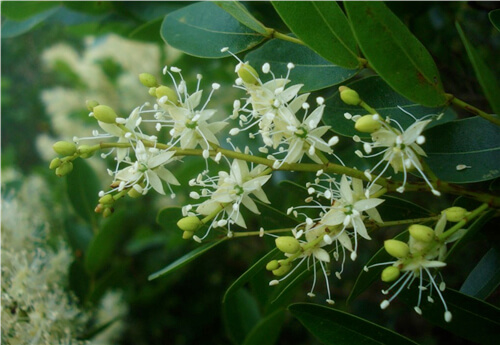
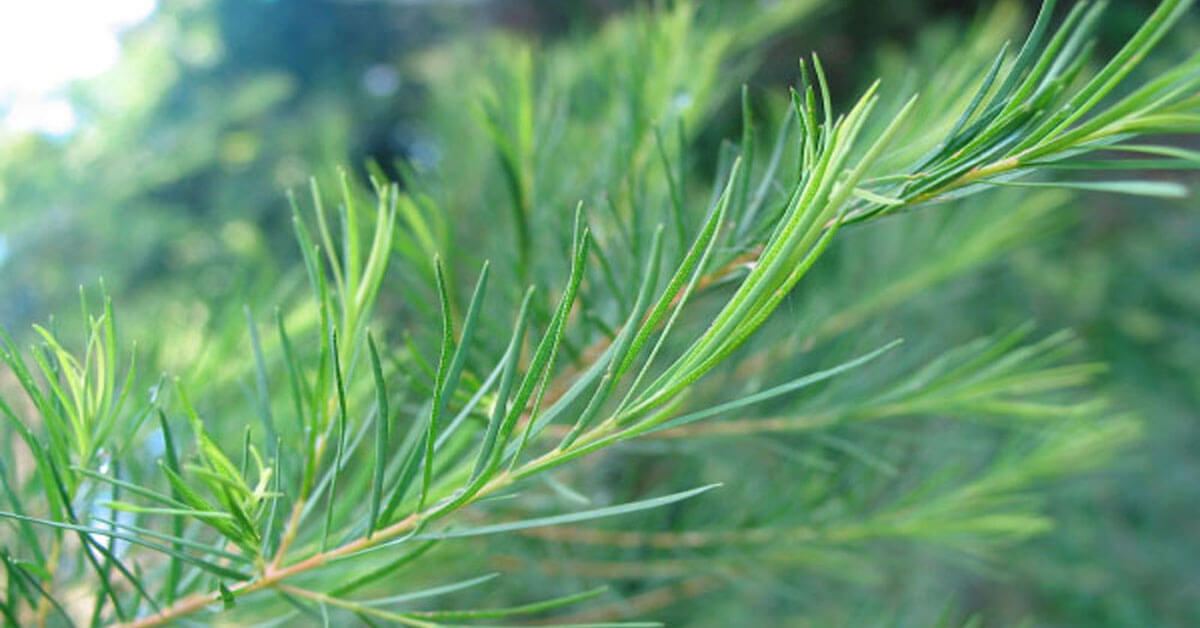
Description: The genus Melaleuca belongs to the myrtle family (Myrtaceae) and includes about 250 species (including the paperbarks, some of which are cultivated as ornamentals). Most Melaleuca species are restricted to Australia. M. alternifolia bears fluffy, white masses of flowers from spring to early summer, and its narrow leaves help distinguish it from the similar species M. linariifolia, which has wider leaves and flattish-spherical fruits.1 Melaleuca alternifolia is native to Australia, where it is found from Queensland to north-east New South Wales, at up to 300 m above sea level.
Captain James Cook, the 18th century explorer, is reported to have used tea tree leaves to brew a spicy tea, although the common name ‘tea tree’ has been applied to several plants in the genera Melaleuca and Leptospermum (also in Myrtaceae), so the exact species he used is unknown.2
EXTRACTION INFORMATION
Country of origin: Australia, New Zealand
Part of plant used: Leaves
Extraction method: Steam distillation
Essential oil yield: 2.0 – 5.0%
Color of oil: Clear to pale yellow
AROMATIC CHEMISTRY
One hundred plus components make up the essential oil of tea tree. Core components include terpinen-4-ol (30-48%), -terpinene (10-28%), and eucalyptol (trace to 15%). Other components include:
Monoterpenes: terpinolene (1.5-5%), a-terpinene (3.09-13%), -terpinene (10-28%), p-cymene (0.5-8%), limonene (0.5-1.5%), sabinene (t-3.5%), a-pinene (1-6%)
Sesquiterpenes: aromadendrene (t-3%), gamma-cadinene (t-3%)
Monoterpenols: terpinen-4-ol (30-48%), a-terpineol (3.31%)
Ethers/oxides: 1,8 cineole (5.2%)3,4
NOTE: The chemistry of tea tree, in particular its 1,8 cineole and terpinen-4-ol content, has been a subject of great debate, mostly for safety considerations. According to Kerr, the Australian Government has a standard for Tea tree essential oil which states that the 1,8 cineole content should not exceed 15% and the terpinen-4-ol content should be at least 30%.5
SAFETY INFORMATION
- No known contraindications or safety concerns.
- Avoid using oxidized tea tree essential oil on the skin or via the oral route. Tea tree has an average shelf life of 1-3 years when stored properly.
THERAPEUTIC ACTIONS
| System | Action |
|---|---|
| Immune/Lymphatic systems: | anti-allergenic, decongestant (venous and lymphatic), immuno-stimulant |
| Respiratory system: | expectorant, neurotonic, stimulant |
| General: | antibacterial (broad spectrum)6, antibiotic, antifungal7,8, anti-infective (broad spectrum), anti-inflammatory, antimicrobial9, antiseptic, antiviral10 |
SYSTEM AFFINITIES
Digestive, Respiratory, Skin, Urinary
(antimicrobial)
BLENDING INFORMATION
Aroma description: Spicy, warm, balsamic
Blending factor: 3
Notes: Mid, Mid to top
Blends well with: Pine species, black spruce, saro, manuka, ravintsara, blue tansy, rosemary (all chemotypes), eucalyptus (all species), monarda species, green myrtle, spike lavender (L. latifolia), cistus, thyme (all chemotypes), fir, niaouli, lavender
CORE INDICATIONS
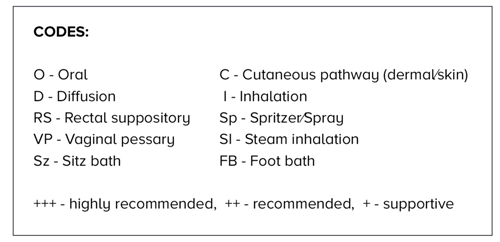
- Digestive system: diarrhea, enteritis, intestinal parasites, dental hygiene, gum problems, infections of the mouth, mouth ulcers, oral thrush (C. albicans), esophageal candidiasis, canker sores, dental abscess, hemorrhoids, rectal fissures, gingivitis (O+++, RS+++,
- Lymph and Immune system: lowered or compromised immunity, lymph congestion (C+++, I++, D++, O+++)
- Reproductive system: leucorrhoea, vaginal candidiasis (O+++, VP+++)
- Respiratory system: colds, flu, bronchitis, rhinitis, sinusitis, congestion, coughs, sore throat, tonsillitis, ear infections, bacterial or viral respiratory infections (O+++, I+++, D+++, C+)
- Skin: acne, nail fungus, oily skins, abscesses, boils, cold sores11, cuts, dandruff, herpes simplex12, insect bites, lice, rashes, shingles, infected wounds, varicose ulcers, athlete’s foot, ringworm, inflamed skin conditions13, varicose veins, juvenile acne, acne rosacea, prevention of skin radiation burns, dermal mycoses (fungal infections) (C+++, Fb+++ (for foot fungas))
- Urinary system: cystitis, urethritis, urinary tract infection (O+++)
RESEARCH
Note: Tea tree (Melaleuca alternifolia) has been extensively researched. Below represents but a small collection of this research.
Human Studies
- Tea tree (Melaleuca alternifolia) essential oil exhibits anti-inflammatory activity.
In this study, twenty-one volunteers were recruited to investigate the anti-inflammatory activity of tea tree (Melaleuca alternifolia) essential oil on histamine-induced inflammation. The group was divided into two: twenty-one participants applied 25 µL (microliters) of 100% tea tree oil to the study forearm and six participants applied 25 µL (microliters) of paraffin oil (the control). In the tea tree group, the developing edema to histamine was significantly reduced. The researchers concluded that tea tree exhibits anti-inflammatory activity which may be of benefit in treating hypersensitivities to insect allergens.14 - Tea tree (Melaleuca alternifolia) essential oil is effective for treating dandruff.
A 5% dilution of tea tree essential oil in shampoo was effective in the treatment of dandruff, potentially related to the yeast Pityrosporum ovale. Tea tree oil exhibited antifungal properties P. ovale and may be useful in the treatment of dandruff.15 - A 5ml solution consisting of tea tree, grapefruit, and eucalyptus (species not specified) essential oils used to rinse ulcers twice a day is found effective at reducing signs of infection and pus secretion and reducing foul odor association with necrotic ulcers. Some patients have also reported a reduction in pain levels.16
- Two case studies involving the use of tea tree (Melaleuca alternifolia) essential oil via inhalation revealed the potential of tea tree essential oil in the treatment of pulmonary tuberculosis. Both patients received a patented tea tree oil (monoterpenes had been removed) in aerosol canisters which they inhaled over a period of 5 – 10 days. For both patients there was a negative for infection after 4-5 days of using tea tree aerosol.17
Animal Studies
- Tea tree (Melaleuca alternifolia) essential oil and terpinen-4-ol effective antifungal against mucosal candiasis.18
- Inhaled tea tree (Melaleuca alternifolia) essential oil demonstrates anti-inflammatory activity.19
In Vitro Studies
- Tea tree (Melaleuca alternifolia) essential oil and its active component, terpinen-4-ol exhibits anti-viral activity against influenza virus.20
- Tea tree (Melaleuca alternifolia) essential oil exhibits effective antifungal activity against Candida albicans infection and may be indicated in the treatment of vaginal candidiasis.21
- Tea tree (Melaleuca alternifolia) essential oil and terpinen-4-ol exhibit anti-proliferative activity against tumor cells.22
- Tea tree (Melaleuca alternifolia) essential oil exhibits anti-candidal activity and inhibition the filamentous form of Candida albicans. Tea tree may be useful in the treatment of oral candidiasis.23