Introduction: What is Botany?
Botany is the scientific study of plants. In Aromatherapy we explore the very basics of botany by way of the taxonomy of plants.
Understanding the plant name
““The naming of plants under the rules of nomenclature is an effort to tell the truth. Its purpose is not to serve the convenience of those who sell plants or write labels or edit books; it is not commercial. Serving the truth it thereby serves everybody. In the end, nomenclature rests on the plants rather than on printed regulations.”
– L.H. Bailey, How Plants Get Their Names
Nomenclature means the naming of things under a system. ‘Nomen’ is Latin for name. When referring to the nomenclature of aromatic plants, we are referring to their Latin binomials. Binomial means a biological species name consisting of two terms, genus and species. It is extremely useful to know the Latin binomials for essential oils, as common names lack precision and botanical binomials are exact. Each binomial or Latin name refers to one kind of plant, critically distinguished from all others. The Latin binomial not only classifies the genus and species, but also provides the plant with a universal name. The Latin name is also internationally recognized, whereas the common name is not.
Historical aspects of plant classification
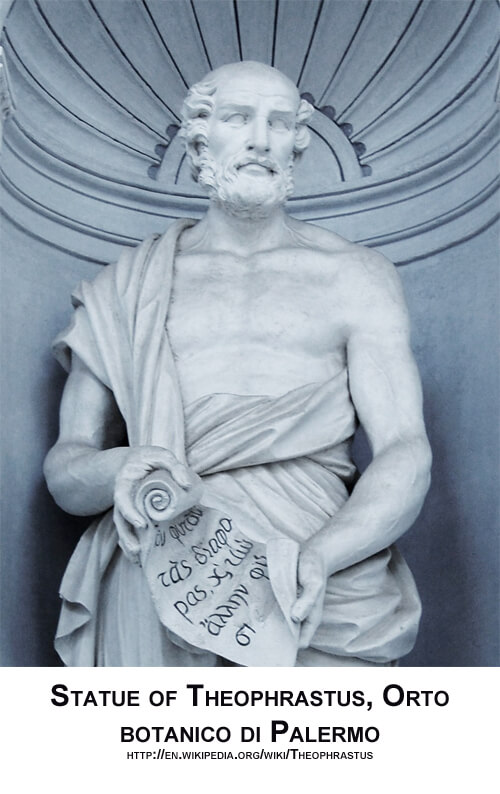 The modern development of plant classification has its origins in ancient Greece. In 300 BC, a student of both Plato and Aristotle, Theophrastus, wrote extensively about plants. He recognized the difference between flowering and non-flowering plants, developed an understanding of the sexuality of plants, and noted that fruits developed from carpels. Theophrastus’ records are some of the earliest to describe over 450 species. The current genus names Asparagus, Narcissus, and Daucus, which are still in use today, can be traced back to his work.1
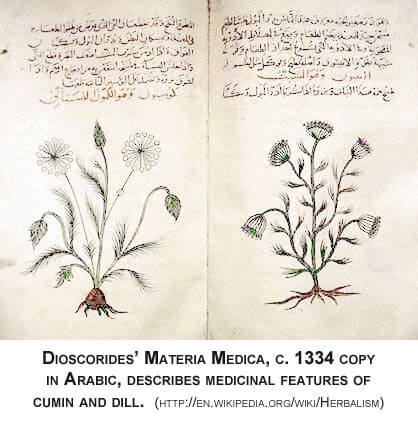
One of the most important books on plant classification during this ancient period, however, was written by Dioscorides in the first century AD.. Dioscorides’ book, Materia Medica, described 600 plant species and their medicinal benefits. Although much of the information has been made more accurate over time, Dioscorides’ Materia Medica is still honored and published today for its immense historical value.
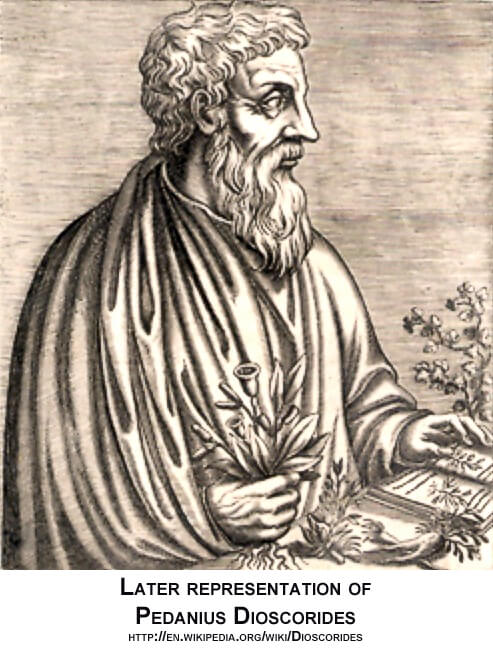
During the Renaissance period, most notably the 16th Century, we begin to see the rise of medicinal plant books, called herbals. By the mid-16th century, these herbals began to include quite precise descriptions of a variety of plants. Most of these herbals contained information on no fewer than 1000 plants.
The origins of botanical nomenclature and their classification arose in the 17th and 18th centuries with the works of Tournefort and, later, Carl Linnaeus. Tournefort wrote three extensive volumes on plant identification that appeared in print in 1700. It was Tournefort who established the concept of the genus, although he used Latin phrases or clauses for plants, instead of concrete names. Carl Linnaeus stabilized the three categories: Genera, species, and varieties. Systematic binomial nomenclature began with Linnaeus in his book Species Plantarum, published in 1753. It was Linnaeus who brought order to the study of plants, and for this is often referred to as ‘the father of botany.’ Linnaeus was a systematist in natural history. He systematized everything, a necessary process to bring together the accumulated records of centuries and place them in orderliness.

Since Carl Linnaeus’ time, the classification and systematics of botanical identification have been further developed. Most plants are currently classified under the natural system of classification, which attempts to follow the evolutionary history, the phylogeny, of the organisms being categorized.
The International Commission for the Nomenclature of Cultivated Plants has formulated and published rules in order to provide international order, to prevent overlapping and error, to stabilize spelling and gender, to guide legislation in separate countries (who have their own national commissions), to decide on reclassification and renaming of plants, and most recently to regulate the naming of cultivars.2
Understanding Basic Taxonomy
The most fundamental level of taxonomic classification is the species, which represents “a kind of plant that is distinct from other kinds in marked or essential features, that has good characters of identification and that may be assumed to represent in nature a continuing succession of individuals from generation to generation.” The species, therefore, are a set of individual plants closely related by descent from a common ancestor.
 A subspecies occurs when cross-pollination of closely related species results in a viable seed that grows into a fertile adult.
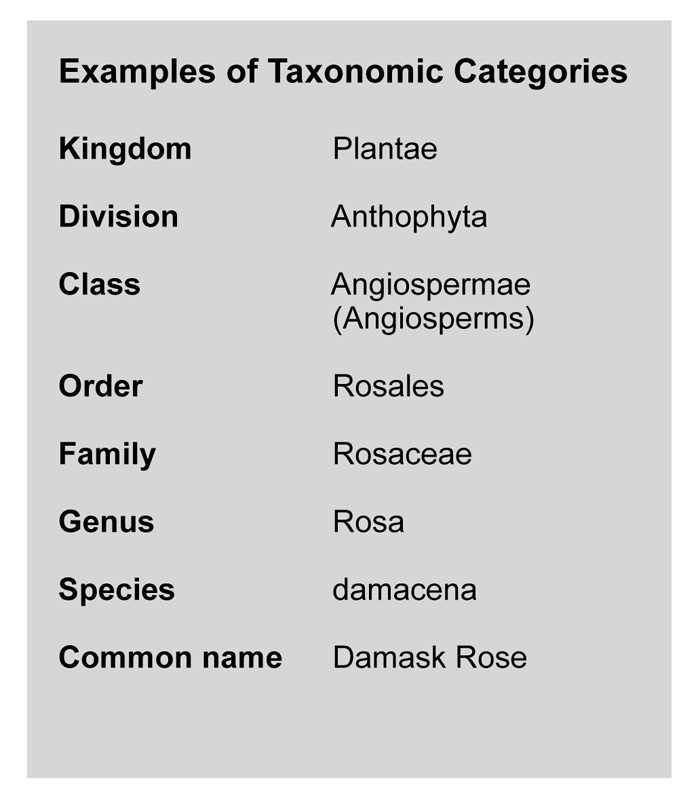
The next level of taxonomic classification is when closely related species are grouped together into genera (the plural of genus). The genus refers to a group or category of plants which are similar in botanical structure. The genus name is always capitalized. The genus and species together make up a plants’ botanical scientific name. The scientific name is always italicized or underlined. For example, Lavender is Lavandula angustifolia.
The level above genus is the botanical family, which is composed of one or several genera. Most families are well defined, with widespread agreement as to which species and genera belong to the particular botanical family.
The botanical family displays a number of genera which have similar characteristics, especially in their reproductive structures. Family names are often derived from a prominent member or a prominent characteristic within the family group. For example, Umbelliferae means ‘bearing umbels or flower clusters with flower-stalks radiating from the same point at the summit of the stem (umbrella shaped).’
Family names are noted with the ending of –aceae (pronounced ace-see-ee). Some families have two names, one of which reflects an old name which continues to be well known and familiar. In Aromatherapy we find the following families with two names:
| Historical Name | Modern Name |
|---|---|
| Compositae | Asteraceae |
| Umbelliferae | Apiaceae |
| Labiatae | Lamiaceae |
| Gramineae | Poaceae |
The levels above family are order, class, division and kingdom, which we shall not concern ourselves with during the study of aromatic plants, except to distinguish between the two classes of Angiosperms and Gymnosperms from which we obtain the vast majority of essential oil plants.
Other types of Classification
Following are types of classifications which occur below the species name. When a subdivision occurs in the species this is referred to as a variety. Varieties can occur in nature or be cultivated in a more controlled environment to have a particular characteristic or set of characteristics (this is known as cultivar). One will see the difference written as follows:
A botanical variety is written as: Cedrus atlantica var. glauca
A cultivar or cultivated variety will be written as: Malus floribunda ‘Gorgeous’ (the cultivar)
The only other item you may come across in your study and use of essential oils in regards to botanical nomenclature is a hybrid. A hybrid is the result of a cross fertilization between two different plant species and/or two varieties within a species. Hybrids are symbolized through the use of a multiplication sign. For example: Lavandula x intermedia is a hybrid between Lavandula angustifolia and Lavandula latifolia.
Classification of the Plant Kingdom
Plants provide nourishment for our bodies and souls. With the help of protists and fungi, plants provide the oxygen we breathe and the food that sustains us — either directly or indirectly, and by feeding other animals. Plants provide shade over our heads and cool carpets under our feet while surrounding us with beautiful colors and marking the change of seasons.
Classification of the plant kingdom can be especially confusing to the amateur aromatherapist. At least four classification systems are in common use.
1. Plants are classified into 12 phyla or divisions based largely on reproductive characteristics.
2. They are classified by tissue structure into non-vascular (mosses) and vascular plants (all others);
3. by “seed” structure into those that reproduce through naked seeds, covered seeds, or spores; or
4. by stature divided into mosses, ferns, shrubs and vines, trees, and herbs.
All of these higher-level groupings are decidedly lopsided: the vast majority of the 270,000 plant species are flowering plants. The categories listed below provide a slightly better balance: the largest phylum has been split while the other phyla are grouped according to one or more of the methods described above.
I. Mosses and Allies (Bryophyta and allies)
Mosses are non-vascular plants — they cannot transport fluids through their bodies. Instead, they must rely on surrounding moisture to do this job for them. Though small in stature, mosses are very important members of our ecosystem. They lay the foundations for other plant growth, prevent erosion, and contribute to the lush green appearance of many forested areas.
The 24,000 bryophyte species, previously grouped into a single phylum, are now grouped in three phyla: Mosses (Bryophyta), Liverworts (Hepatophyta) and Hornworts (Anthoceraphyta). They reproduce by spores, never have flowers, and can be found growing on the ground, on rocks, and on other plants. It is extremely rare to find mosses, liverworts, or hornworts containing essential oils. None are extracted for use in Aromatherapy.
II. Ferns and Allies (Pteridophyta and allies)
Ferns and allies have a vascular system to transport fluids through their bodies, but like the mosses, they reproduce from spores rather than seeds. The main phylum, the Ferns (Filicinophyta = Pteridophyta), includes around 12,000 species.
Three other phyla are included as fern allies: the Horsetails (Sphenophyta = Equisetophyta, 40 species), Club mosses (Lycopodophyta, 1,000 species), and Whisk ferns (Psilophyta, 3 species).
III. Conifers and Allies (Gymnosperms = Coniferophyta and allies)
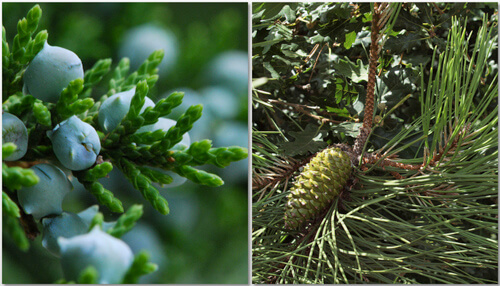
The gymnosperms add the next level of complexity to plant evolution: they reproduce from seeds instead of spores. The seeds, however, are “naked” (Greek: gummnos) — not covered by an ovary. Usually, the seed is produced inside a cone-like structure, such as a pine cone, hence the name “conifer.” Some conifers, such as the Yew and Gingko, produce their seeds inside a berry-like structure.
Conifers are fairly easy to identify. In addition to the aforementioned cones, these trees and shrubs typically have needle-like, scale-like, or awl-like leaves. They never have flowers.
Approximately 600 species are counted as conifers including the pines, firs, spruces, cedars, junipers, and yew. Species within the conifer ranks give us pine nuts (pesto’s magic ingredient) as well as juniper berries for gin.
Conifer allies include three small phyla containing fewer than 200 species altogether: Gingko (Ginkophyta) with a single species, the Maidenhair Tree (Gingko biloba); palm-like Cycads (Cycadophyta); and herb-like cone-bearing plants (Gnetophyta) such as Ephedra.
IV. Flowering Dicot Plants (Angiospermophyta, Class Dicotyledoneae)
Angiosperms add the final evolutionary improvement to plant reproduction: they grow their seeds inside an ovary (Greek: angeion = vessel) which is, itself, embedded in a flower. After it is fertilized, the flower falls away and the ovary swells to become a fruit.
Here is a video about the Angiosperms.
Angiosperms in the class Dicotyledoneae grow two seed-leaves (cotyledons). In addition, foliage leaves typically have a single, branching, main vein originating at the base of the leaf blade, or three or more main veins that diverge from the base.
The vast majority of plants are dicots. Most trees, shrubs, vines, and flowers belong to this group of around 200,000 species. Most fruits, vegetables and legumes come from this class as well.
Aromatic plants based upon the two classifications: Gymnosperms and Angiosperms
Gymnosperms: Seed plants
On the evolutionary scale, gymnosperms are more primitive than the angiosperms but are of considerable economic importance. For instance, softwoods such as pine and fir are not only used to make paper, lumber, and plywood, but are the source of utilitarian products such as pitch, turpentine, and rosin.3
The Gymnosperms (gymno = naked; sperma = seed), are plants which have seeds that develop on the surface of the reproductive structures (thus also called the “naked-seed plants”). For example, the pine tree has its seeds between the flap-like parts that make up the pine cone.4 Gymnosperms are always pollinated by wind, and many have their seed-bearing structures organized into cones. There are four major divisions of plants within the gymnosperms:
- Ginkgophyta (Ginkgo: maidenhair tree)
- Cycadophyta (Cycads)
- Gnetophyta (Gnetophytes),
- Pinophyta or Coniferophyta (the conifers)
For our purposes, we shall be studying those gymnosperm plants that belong to the fourth group: the Coniferophyta.
Division: Coniferophyta
Order: Coniferales: Conifers
With approximately 50 genera and 550 species, the conifers are the most diverse and familiar of the gymnosperms. Conifers vary in height from moderate to gigantic. Conifers are never vines, herbs, or annuals, and they never have bulbs or rhizomes. Conifers bear leaves which are always simple and are either needles or scales. All conifers have both pollen cones and seed cones.
The most common gymnosperm plants used within aromatherapy come from two families within the order of the Coniferales. These two families include the Pinaceae family and the Cupressaceae family.
| Taxonomic Categories leading to the: | Pinaceae Family | Cupressaceae Family |
|---|---|---|
| Kingdom | Plantae | Plantae |
| Division | Coniferophyta | Coniferophyta |
| Class | Pinopsida | Pinopsida |
| Order | Pinales | Pinales |
| Family | Pinaceae | Cupressaceae |
These families contain a wide range of essential oils, most with a strong affinity to the respiratory, immune, and circulatory systems. The chart below outlines the most common genera of aromatic plants utilized for their essential oils. They are categorized according to the botanical family they belong to.
| Families of the Order Coniferales: Conifers | |
|---|---|
| Botanical Family | Aromatic Plants in Family |
| Pinaceae | Abies (firs), Cedrus (cedar), Larix (larch), Picea (spruce), Pinus (pine), Pseudotsuga (Douglas fir), Tsuga (hemlock) |
| Cupressaceae | Cupressus (cypress), Juniperus (juniper), Libocedrus (incense cedar), Thuja (arborvitae) |
Now, let’s explore the most common essential oil species found in these families.
The Pinaceae and Cupressaceae Families
Pinaceae
Pinaceae (the pine family) are trees or shrubs, including many of the well-known conifers of commercial importance such as cedars, firs, hemlocks, larches, pines, and spruces. Within the confier family, Pinaceae have the largest species diversity, with between 220-250 species (depending on taxonomic opinion) in 11 genera, and the second-largest (after Cupressaceae) in geographical range. They are found in most of the Northern Hemisphere, with the majority of the species in temperate climates, but ranging from sub-arctic to tropical. The family often forms the dominant component of boreal, coastal, and montane forests. They are trees (rarely shrubs) growing from 2 to 100 meters tall, mostly evergreen (except Larix and Pseudolarix, which are deciduous), resinous, monoecious, with subopposite or whorled branches, and spirally arranged, linear (needle-like) leaves.5
| Pinaceae Family | |
|---|---|
| Genus | Species |
| Abies (fir) | Abies alba, Abies balsamea, Abies grandis, Abies lasiocarpa |
| Cedrus (cedar) | Cedrus atlantica, Cedrus deodora |
| Picea (spruce) | Picea mariana |
| Pinus (pine) | Pinus edulis (Pinon pine), Pinus strobus, Pinus resinosa, Pinus pinaster, Pinus sylvestris |
| Pseudotsuga | Pseudotsuga menziesii (Douglas fir) |
Cupressaceae
The Cupressaceae or cypress family is a conifer family with worldwide distribution. The family includes 27–30 genera, including the junipers and redwoods, and 17 monotypic species. (a monotypic species is one that does not include subspecies or smaller, infraspecific taxa). There are about 142 species in total6, making it the largest conifer family in terms of genera, and the third-largest in terms of species.7
| Cupressaceae Family | |
|---|---|
| Genus | Species |
| Cupressus (cypress) | Cupressus sempervirens |
| Juniperus | Juniperus virginiana (cedar), Juniperus communis (juniper), Juniperus mexicana (cedar) |
| Thuja (arborvitae) | Thuja occidentalis |
Angiosperms – Flowering plants
Angiosperms are plants in which the ovules, or young seeds, are enclosed within an ovary (the part of a flower specialized for seed production). Also known as the flowering plants, angiosperms have leaves, roots, and stems, and vascular, or conducting tissue. Constituting the plant division Magnoliophyta (sometimes called Anthophyta), they are divided into dicotyledons, which have two seed leaves (cotyledons) and cambium tissue in the stems, and monocotyledons, which have one seed leaf and generally lack cambium tissue. Angiosperms are the most important plant group economically as they include all agricultural crops and cereal grains, all garden flowers, and almost all broad-leaved trees and shrubs. There are over 250,000 flowering plants.
The families, genera, and species listed below are only those from which essential oils are commonly extracted.
| Angiosperm Families and Genera | |
|---|---|
| Family | Genus |
| Annonaceae | Cananga |
| Apiaceae / Umbelliferae | Ammi, Anethum, Angelica, Apium, Bupleurum, Carum, Coriandrum, Cuminum, Daucus, Foeniculum, Petroselinum |
| Asteraceae/Compositae | Achillea, Anthemis, Arnica, Artemisia, Calendula, Chamaemelum, Echinacea, Eriocephalus, Helichrysum, Inula, Matricaria, Tagetes, Tanacetum |
| Betulaceae | Betula |
| Burseraceae | Boswellia, Bursera, Canarium, Commiphora |
| Canellaceae | Cinnamosma (saro) |
| Cistaceae | Cistus (cistus) |
| Ericaceae | Gaultheria, Ledum (greenland moss) |
| Fabaceae* | Copaifera (Balsam Copaiba) (*not covered in this course.) |
| Geraniaceae | Pelargonium |
| Lamiaceae/Labiatae | Hyssopus, Lavandula, Melissa, Mentha, Monarda, Nepeta, Ocimum, Origanum, Pogostemon, Rosmarinus, Satureja, Salvia, Thymus |
| Lauraceae | Aniba, Cinnamomum, Laurus, Litsea, Ravensara |
| Myristicaceae | Myristica |
| Myrtaceae | Eucalyptus, Eugenia, Leptospermum, Melaleuca, Myrtus, Pimento |
| Oleaceae | Jasminum |
| Piperaceae | Piper |
| Poceae / Gramineae | Cymbopogon |
| Rosaceae | Rosa |
| Rutaceae | Citrus |
| Santalaceae | Santalum |
| Schisandraceae | Illicium (star anise) **not covered in this course. |
| Valerianaceae | Nardostachys , Valeriana |
| Zingiberaceae | Curcuma, Elettaria, Zingiber |
A list of essential oils covered in this course (with a couple of exceptions) can be found in the Lesson PDF, at the end of this lesson.
In the next module you will explore individual essential oils found in each family.
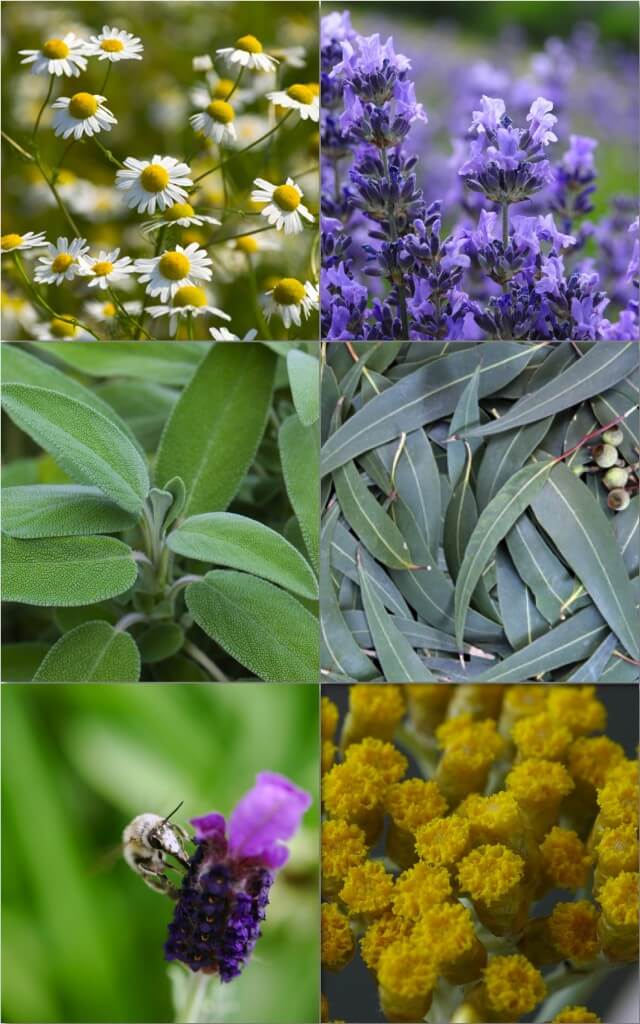 The most fundamental level of taxonomic classification is the species, which represents “a kind of plant that is distinct from other kinds in marked or essential features, that has good characters of identification and that may be assumed to represent in nature a continuing succession of individuals from generation to generation”. The species, therefore, is a set of individual plants closely related by descent from a common ancestor. Species has to do with direct characteristics of the plant including leaf structure, flower structure, reproduction and other characteristics within a family of plants.