Watch: Introduction to Essential Oil Monographs with Jade Shutes
Cultivating our relationship with essential oils
Essential oils are at the heart of our practice as aromatherapists, our core tools for supporting health and wellness as well as for treating imbalances and pathophysiological states. With so much information (both good and bad) being conveyed through social media about different essential oils, along with a growing emphasis on chemistry and biomedical/pharmaceutical derived information for their toxicity and therapeutic actions, it is our responsibility to ensure we have a strong foundation in our knowledge and experience of each essential oil we use so as to better integrate and evaluate the information or infographics we may come across.
Cultivating a personal relationship with each essential oil in one’s repertoire of aromatics is therefore paramount. Beyond the above reasons, cultivating a personal relationship with each essential oil provides you with the confidence and empowerment in using them for diverse clients and a wide range of health conditions or imbalances.
The aromatherapy monographs have been created to provide you with a range of information that supports and encourages this relationship.
Each essential oil monograph covers the following information:
BOTANICAL INFORMATION
Common names: Sweet Marjoram
Scientific (Latin) name: Origanum majorana L.
Botanical family: Lamiaceae
Conservation status: Not defined
Nomenclature and conservation status: The first part of the plant monograph informs us about the plant’s classification and nomenclature: its vernacular names, Latin name, the botanical family, and, and the conservation status of the plant. In the above example, the vernacular name is: sweet marjoram.
Common names, otherwise known as vernacular names, are included so you can link common names with the Latin.
The Scientific (Latin) name is composed of the genus, in this case Origanum; the species name, majorana; and the botanist who first described the plant noted with an abbreviation such as ‘L.” (L. refers to the botanist, Linnaeus). The Latin name can provide a lot of useful information. It is more precise than common names, which can be ambiguous: the same common name can apply to different plants, and the same plant can be known by different common names. Each plant only carries one valid Latin name, but the Latin names are updated from time to time. Sometimes we commonly refer to a plant by its previously accepted Latin name. To accommodate this, we may list the previously accepted (and older) Latin names as synonyms.
Sweet marjoram (Origanum majorana) belongs in the family known as the Lamiaceae. An awareness of plant families will help you create a framework through which you can derive similarities in traits, either physical or biochemical.
*Find names of botanist by their initials here: https://en.wikipedia.org/wiki/List_of_botanists_by_author_abbreviation_(P)
Occasionally a plant has more than one botanical name which is represented with the word syn or synonym which means ‘the same as’. *All Latin names have been verified by using: Germplasm Resources Information Network and the United States Department of Agriculture, Natural Resources Conservation Service.
Botanical family: Each essential oil bearing plant belongs to a specific botanical family. Often a group of plants within one given botanical family will have common characteristics, whether chemically or in therapeutic action. Occasionally there are two names, one followed by the word ‘syn’, meaning ‘the same as’. The first name is the most current and accepted name while the second one is its formerly accepted name. This can be helpful in researching an essential oil as information will be listed under both the older and modern names.
Conservation status:
The conservation status informs us to what degree a plant is likely to become extinct in the wild. The medicinal use of plants is responsible for the depletion and even extinction of wild plants. Information on conservation status is taken from the IUCN Red List, which defines extinction risk using criteria such as areas of occupancy, population numbers, reproductive rate and success, current and projected threats to the species and its habitat, and so on.
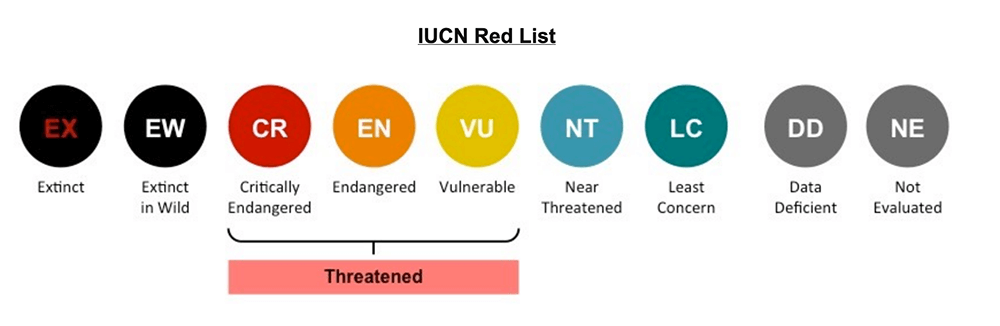
Conservation status ranges from Least Concern, which means the plant is not threatened, all the way to Extinct, meaning it has disappeared completely. In between these extremes are Near Threatened, Vulnerable, Endangered, Critically Endangered, and Extinct in the Wild. This information should guide which plants (essential oils) you use and how you source them.
Extraction Information
Country of origin: The country of origin reflects the country where the essential oil is either indigenous or where it is cultivated or harvested in the wild for the express purpose of distilling and yielding an essential oil. The country of origin can considerably affect the chemical composition of the essential oils.
The country of origin can also have an affect, or perceived effect, on the quality of the oil produced. For instance, most aromatherapists believe Bulgarian rose (Rosa damascena) to be far superior to Turkish rose of the same species & Lavender (Lavandula angustifolia) from the high altitudes of France to be superior to the Tasmanian, Croatian, or American essential oil from the same species. Although it is true, the evaluation of the aroma of the rose, for example, is in the nose of the one who is smelling!
Part of plant used: This is the part of the plant distilled to obtain the essential oil. Note: The term ‘flowering tops’ means that the flowers and top leaves are distilled.
Extraction method: The most common method of extraction for that particular plant
Essential oil yield: (v/w) ¥ (v/w) This means the yield of essential oil in volume, typically milliliters per 100 grams of plant material. Thus, the yield is dependent upon the amount of plant matter processed. For instance, geranium 0.3- to 2% per 100 grams. This means one would yield approximately 0.3 to 2 mls of essential oil per 100 grams of plant material by weight.
Occasionally, the yield will be given in w/w terms which means the yield of essential oil in weight (grams) per 100 grams of plant material.
The essential oil yield as well as the chemical composition of an essential oil is influenced by environmental factors such as moisture, temperature, light intensity, soil type, salinity of soil, nutrition, and the amount of sunlight the plant receives. Other factors include genetics, abiotic and biotic stressors.
Color of oil: A description of the color range of the individual essential oil
AROMATIC CHEMISTRY:
Essential oils may contain over 200+ unique chemical components, many of which may appear at less then 1%. Each essential oil has, what are considered to be, active or major chemical components that influence its therapeutic activity and behavior. In this section, the major components are provided.
NOTE: The chemical composition of any individual essential oil can vary greatly depending on country of origin, environment, harvest time, etc.
As aromatherapist, we are able to generalize some of the therapeutic activity of an essential oil via the chemical family or families of components most present in a given essential oil. We are also able to obtain insight into the therapeutic activity of an essential oil due to the presence of specific components.
For instance, an essential oil rich in esters is considered to be generally calming to the nervous system whereas an essential oil rich in phenols will be highly effective as an antimicrobial agent. We could be even more specific by stating something like: The active components of Lavandula angustifolia essential oil are linalool (a monoterpene alcohol) and linalyl acetate (an ester). These components contribute to the sedative and anti-inflammatory activity of Lavandula angustifolia essential oil.
SAFETY INFORMATION
This section lists the current safety data for the essential oil.
THERAPEUTIC ACTIONS
This section details the therapeutic activity of the essential oil. The actions listed are those that have either empirical acceptance or that can be supported by research. Please note that some of the research references are placed in this section. This research is typically based upon in vitro or animal studies unless otherwise noted. The core actions for which the essential oil is most used and known for within aromatherapy practice are highlighted in bold text.
SYSTEM AFFINITIES
An essential oil often displays a certain affinity with a specific system, organ, or function. In this section, we list the core systems of the body for which the essential oil has an affinity. Herbs and essential oils often have a predilection for a certain organ or function. This is called a tropism.
BLENDING INFORMATION
- Aroma description: The general description of the aroma of the individual essential oil
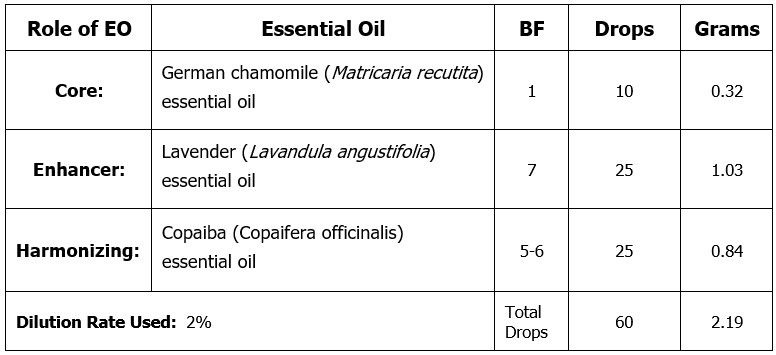
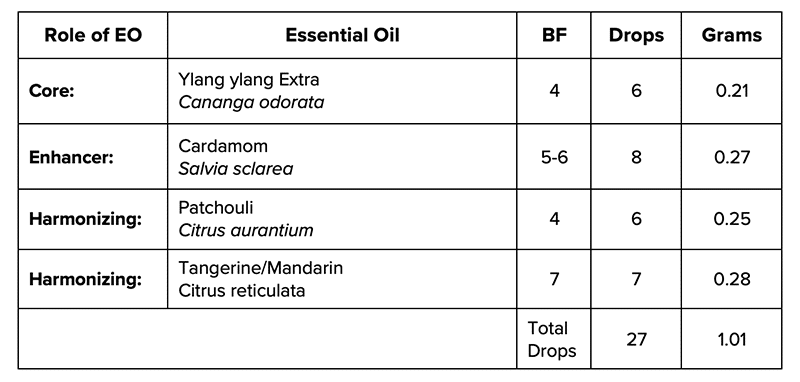
- Blending factor: The blending factor is a tool designed to support the formulation of balanced blends and synergies.
- Notes: The note theory was adopted from the perfume industry. Base notes evaporate more slowly than top notes. Base notes are used as fixatives while top notes represent the first aroma smelled. Mid notes are used to balance the blend in perfumery.
CORE INDICATIONS
This section is designed to list the most common and traditional uses of the essential oil. Like the Therapeutic actions section, these indications are those which can be supported by either strong empirical (experience or clinical practice), clinical research, or other relevant research.
The core indications are listed first for systems of the body and then for emotion/psyche applications. They are not in any particular order of importance or effectiveness.
CODES
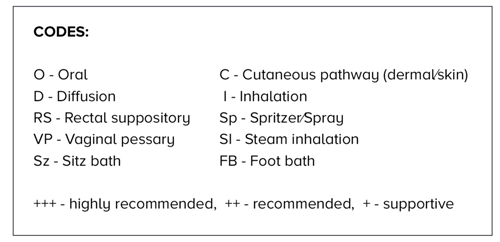
In the Core Indications section after each system there are one or more codes such as C+++, O++, or D+. These codes indicate route of administration (e.g. C – cutaneous) and whether that method is highly recommended, recommended or supportive. The chart below outlines the codes used throughout the monographs on essential oils.
RESEARCH
The use of scientific research to support various properties of essential oils is in vogue in todays aromatherapy community. Often however, there is little clarity as to whether the study as on humans, animals, or in vitro. The School for Aromatic Studies monographs clearly present Human studies, Animal studies, and In vitro studies. When possible, a link has been provided in the Reference section noted with: ‘Retrieved from’. Other papers have been purchased and are unable to be shared.